Formula One: Max Verstappen clinches title in end of season decider
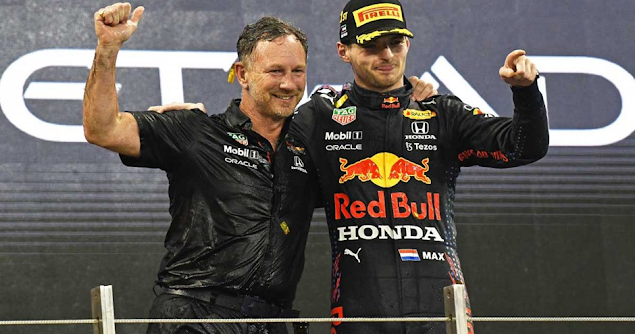
Yesterday Max Verstappen won the Formula One World Drivers’ Championship title in a last-race decider, bringing one of the most thrilling seasons in the sport’s history to a close.
The final showdown between Verstappen, driving for Red Bull,
and his Mercedes rival, seven-time champion Lewis Hamilton, began on Saturday
with qualifying. The practise sessions earlier seemed to indicate that Mercedes
had the edge. Yet it was Verstappen who clinched pole, setting the fastest lap
through excellent coordination with his teammate, Sergio Perez, who gave Max a
tow to boost his speed.
However, when the race began, Hamilton got the better start
and moved ahead. Verstappen stayed with the Mercedes, though, and on turn six
seized on an opportunity to retake the lead, moving ahead on the inside of
Hamilton. This prompted Hamilton to go off track and rejoin ahead of the Red
Bull, a move which, despite giving an advantage to the Mercedes, received no
punishment from the stewards (in contrast to the orders to Verstappen to give
the position back a week earlier at Saudi Arabia).
From there, the championship contenders made their pitstops
on lap thirteen (Verstappen) and fourteen (Hamilton), leaving Perez in the
lead. Hamilton, with his Mercedes engine having built up a significant lead
over Verstappen, then caught up to Perez and looked to pass the second Red Bull
and regain first place. Perez, however, was not in the mood to take this lying
down, and over the subsequent two laps defended brilliantly, denying Hamilton
the lead and slowing him down. By the time the Mercedes did pass, Verstappen
was back in contention, and clearly appreciative of his teammate’s efforts –
‘Checo’s a legend’, he said over the radio. After so many years of struggling
to find the right second driver, Perez’s brilliant team game this weekend,
together with his win at Baku and several podiums over the season, seems to
confirm that Red Bull have finally found the right man.
The two rivals were within touching distance again, but as the race progressed it seemed as though there was simply too much pace in the Mercedes and the gap grew again. A chance for Red Bull came on lap thirty-five, as Antonio Giovinazzi's Alfa Romeo came to a stop on the side of the track, leading to a virtual safety car (VSC). During this window Verstappen came into the pits for fresh tyres, while Hamilton remained out. Once the VSC period ended, Verstappen had to make up at least 0.8 seconds a lap to catch Hamilton. The new tyres gave the Red Bull extra pace, but it seemed as though Verstappen had too much to do in the laps left, and the gap remained above ten seconds. Hamilton looked set for an eighth title, and from the Red Bull garage Christian Horner was speaking of the need for a miracle.
Yet, fittingly for a season that has produced so many surprises, there would be a final twist in Abu Dhabi. For, on lap fifty-three, Nicholas Latifi’s Williams crashed, requiring the safety car to be brought out as marshals cleared the debris. With the field bunched up, there was once again an opportune moment for a cheap pit stop. Red Bull called Verstappen in for soft tyres in case the race ended in a last-minute sprint. Mercedes, on the other hand, prioritised track position and kept Hamilton out.
However, the longer it took for Latifi’s car to be removed, the more it seemed as though speculation over tyres and the race resuming would come to nothing. Would the race that had been billed as the ‘decider in the desert’ come to an end in the most anti-climactic fashion, via safety car? It took until the eleventh hour, on lap fifty-seven, for an answer to be given by race director Michael Massi – the race would resume. The five lapped cars between Hamilton and Verstappen were allowed to unlap themselves and pass the safety car, which would come in on lap fifty-eight. Effectively, there was to be a last-lap shoot-out for the title.
When the final lap began, it was game on. The two rivals set off, and it quickly became clear that Verstappen and Red Bull's gamble on the soft tyres had paid off - Verstappen overtook Hamilton on turn five. The Red Bull then resisted attempts by the Mercedes to reclaim the lead, and by the final turn was two seconds ahead. Verstappen took the chequered flag and, with it, the world championship.
Even before the race had finished, there were rumblings from the Mercedes garage over this last-lap decider. Once the race was over, these rumblings turned into two formal complaints from the team, which would be thrown out by the stewards. It is worth pointing out why the correct decision was made, and why, ultimately, the right man won the title. First, it would have been a travesty for such a close season to be decided by a safety car. Only racing (i.e., what Formula One is) could decide who, Verstappen or Hamilton, would lift the trophy. Had all lapped cars been allowed to pass the safety car, then the lap of racing would have not occurred. Letting the five past allowed the racing lap to take place. Formula One and the FIA could not repeat the washout at Spa, when the final standings were decided by a procession behind a safety car. The subsequent stewards’ ruling, confirming Massi’s decision and throwing out Mercedes’ complaints, confirms that these sentiments have a good grounding in the sport’s rules. Second, while Mercedes may point out that Hamilton had a significant lead before the safety car, it is worth noting that this position only came about in the first place because of the blatant course cutting on lap one, which was never punished.
Finally, and perhaps most importantly, regardless of the outcome of this grand prix, it is difficult to look at the season as a whole and not conclude that Verstappen has been the better driver. In every race where he neither retired or suffered damage, Verstappen clinched either first (chalking up ten victories, some dominant, such as the Austrian GPs, Holland, and Mexico, and others going down to the wire, requiring real fighting spirit, such as France and the US) or second. Such consistency is doubly impressive given that Mercedes has still had a mechanical edge (hence their eighth constructors’ title), and a clear one at that since Brazil. Indeed, arguably the reason why the championship was still in contention at Abu Dhabi was because of misfortune on Verstappen’s part – at Baku, at Silverstone, and at Hungary. Would it really have been fitting, with less wins and less laps led, for Hamilton take the title, by virtue largely of better luck and an engine turned up in the last four races? The safety car represented, as Verstappen remarked in post-race interviews, finally some luck going Red Bull’s way.
Verstappen was therefore a worthy world champion when he
crossed the line, and his victory represents a huge achievement for both
himself and for Red Bull, ending Mercedes’ seven-year dominance of the sport.
It is a win that Verstappen very much deserves and one that no one can take
away from him. And, at the age of twenty-four, this is only the beginning of
what looks like an exciting career for Verstappen, with further success no
doubt ahead.

Comments
Post a Comment